
For decades, the “digital revolution” promised to simplify our lives. Yet, for many, technology has felt like a one-way street: governments use high-tech cameras to issue traffic fines in milliseconds, while citizens still spend hours navigating clunky 1990s-era websites to file taxes or claim basic benefits.
The concern raised by Vikas is poignant: Is AI being used to empower the state at the expense of the individual, or can it be the ultimate tool for human liberation?
To bridge this gap, we must move away from “Extractive AI”—systems designed to monitor and penalize—and toward “Proactive AI”—systems designed to serve and protect.
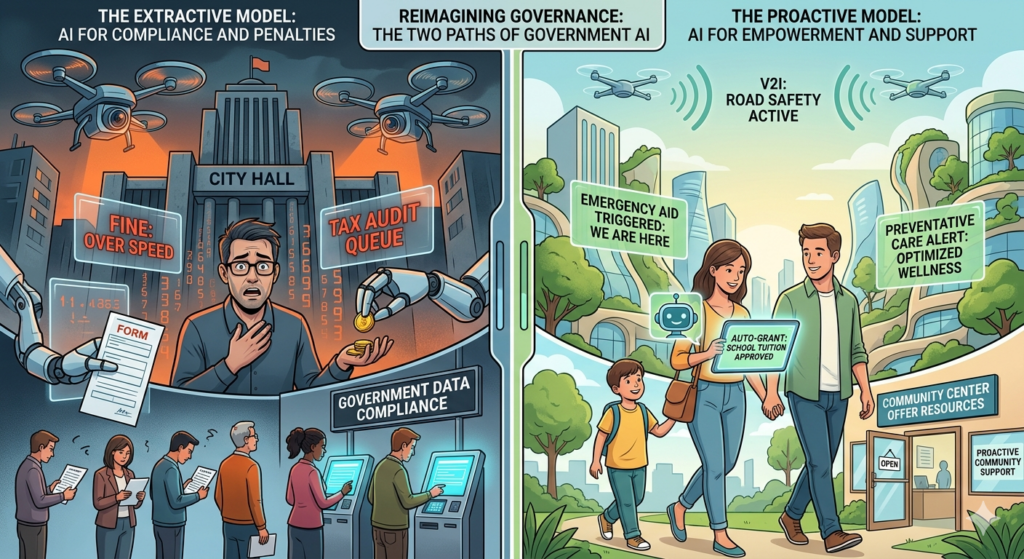
1. From Tax Compliance to “Zero-Touch” Revenue
In many countries, filing taxes is a grueling ritual where the individual does all the math, and the government simply waits to penalize them for a mistake. It’s a “gotcha” system.
- The Old Way: You spend weeks gathering receipts, filling out forms, and fearing an audit.
- The AI Evolution: In a proactive state, the government already has your income data. AI can automatically calculate the most favorable deductions for you, sending a simple notification: “Based on your data, we’ve maximized your return. Click here to confirm your $2,000 refund.” * The Vision: Countries like Estonia are already moving toward “invisible” services. If the system knows you qualify for a tax break, AI should apply it automatically, rather than waiting for you to discover it.
2. From Traffic Fines to Dynamic Safety
Currently, AI in traffic is often synonymous with speed cameras—revenue generators that punish after the fact.
- The Old Way: A hidden camera catches you going 5 mph over the limit on an empty road; a bill arrives three weeks later.
- The AI Evolution: Instead of a “fine-first” model, AI-integrated infrastructure can use real-time data to prevent violations. Smart haptic feedback in cars or localized HUD (Heads-Up Display) alerts could warn drivers of changing limits or hazards before a violation occurs.
- The Pivot: If the goal is safety, AI should manage flow to eliminate congestion, making traffic violations a rarity rather than a budget line item for the city.
3. The “Reverse Emergency” Model: We Call You
Perhaps the most impactful shift is in crisis management. Traditionally, the burden is on the victim to reach out—if they are even able to.
- The Old Way: An elderly person falls at home or a citizen loses their job. They must navigate a maze of phone menus or paperwork to get help.
- The AI Evolution: Using predictive analytics and IoT (Internet of Things), the government can detect anomalies.
- Health: Wearable data or smart meter patterns could alert emergency services to a potential stroke or fall before a neighbor even notices.
- Economic Crisis: If a company files mass layoffs, AI can automatically trigger unemployment benefits, suggest tailored job openings, and pause utility bills for that individual—before they even ask.
Real-World Examples of the Shift
| System | Traditional Problem | The AI Solution |
| Healthcare | Patients wait months for screenings; diseases go unnoticed. | India’s AI for Eye Care: AI screening tools in rural areas detect diabetic retinopathy instantly, allowing the govt to reach out to at-risk patients for treatment before they go blind. |
| Social Services | “The Benefit Gap”: Eligible people don’t know how to apply for food/housing aid. | Benevis (USA): AI tools that scan state databases to proactively find families eligible for benefits and enroll them automatically. |
| Infrastructure | Potholes and leaks are fixed only after they cause damage. | Predictive Maintenance: Cities like Barcelona use AI sensors to fix water leaks or road cracks before they become public nuisances. |
The Moral Imperative
The technology to make life “easy” already exists. The barrier isn’t the code; it’s the intent.
If governments continue to use AI primarily as a digital “hall monitor,” public trust will erode. But if we pivot toward a model where the state uses its processing power to handle the “day-to-day things” that keep us busy—taxes, forms, scheduling, and crisis detection—we return something priceless to the citizen: Time.
The ultimate evolution of a tech-advanced country isn’t a smarter police state; it’s a state that is so efficient, it becomes almost invisible, allowing its people to focus on living rather than complying.